

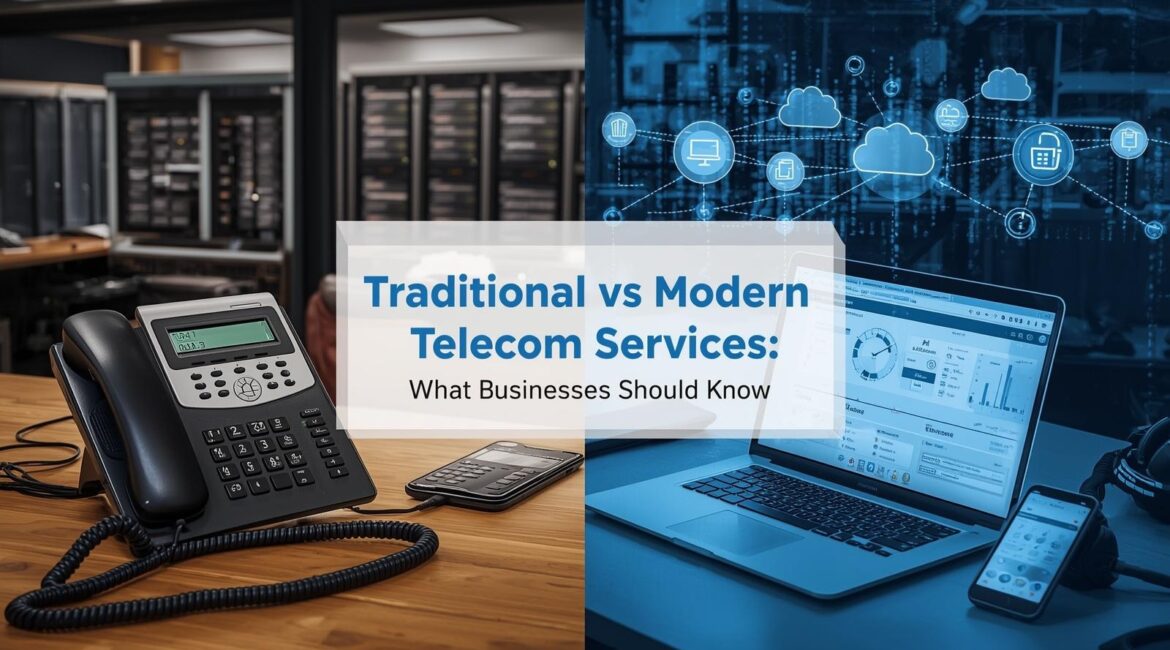
Businesses today face a critical decision in connectivity: stick with traditional telecom services or shift to modern alternatives. Legacy systems like PSTN and copper-based lines limit growth, while modern telecom services—powered by IP-based technologies—deliver speed, flexibility, and innovation. This shift matters because outdated infrastructure hampers remote work, data-heavy operations, and digital transformation.
For instance, many enterprises still rely on traditional setups for voice and basic networking. However, modern telecom services enable seamless cloud integration and support for IoT. In fact, global telecom service revenues reached about $1.53 trillion in 2024, yet traditional segments stagnate while modern adoption surges.
Businesses that upgrade gain a competitive edge. Modern solutions reduce downtime, boost productivity, and support emerging needs like AI-driven operations. This article compares both approaches so decision-makers can choose wisely.
Traditional telecom services, often called legacy or PSTN-based, use dedicated copper lines for voice and data. They provide reliable basic connectivity but lack adaptability.
Modern telecom services leverage IP networks, including VoIP, 5G, fiber, cloud UC, and SD-WAN. These deliver higher performance and integration.
Businesses increasingly migrate because modern options align with hybrid work and digital demands. For example, telecom network services now emphasize software-defined architectures over rigid hardware.
Why Do Businesses Need to Compare Traditional and Modern Telecom Services?
Businesses evaluate these options to optimize operations and future-proof infrastructure. Traditional systems offer familiarity, but modern ones provide measurable advantages in efficiency and scalability.
Many organizations report improved outcomes after switching. Modern telecom services support faster data transfer and lower latency, essential for real-time applications.
What Defines Traditional Telecom Services for Businesses?
Traditional telecom services rely on circuit-switched networks like PSTN and ISDN. These deliver consistent voice quality without internet dependency.
However, they struggle with bandwidth-intensive tasks. Global fixed voice revenue declines steadily, as businesses move away from legacy lines.
What Makes Modern Telecom Services Stand Out?
Modern telecom services use packet-switched IP networks. Key examples include VoIP for voice, 5G for mobile, and SD-WAN for optimized routing.
These enable features like unified communications and edge computing. Global 5G connections exceeded 2.6 billion by mid-2025, reflecting rapid enterprise uptake.
How Do Performance and Reliability Compare?
Modern telecom services outperform in speed and uptime. 5G offers up to 10-100 times faster data rates than 4G equivalents, with latency under 10ms in many cases.
Traditional services provide stable calls but falter under heavy loads. Enterprises using modern setups experience 94% less network downtime with SD-WAN integrations.
Scalability: Which Option Grows with Your Business?
Modern telecom services scale effortlessly. Add users or bandwidth via software, without physical installs.
Traditional systems require hardware upgrades, causing delays. Businesses expand faster with cloud-based VoIP, which supports remote teams seamlessly.
What Security Features Do Each Provide?
Modern telecom services incorporate advanced protections like zero-trust and encryption. SD-WAN adds intelligent threat detection.
Traditional lines offer basic security but lack modern defenses against cyber threats. Enterprises prefer modern options for compliance and data protection.
Integration with Cloud and Emerging Technologies
Modern telecom services integrate natively with cloud platforms. This supports AI, IoT, and collaboration tools.
Traditional services limit such connectivity. For example, private 5G enables secure campus networks for manufacturing.
Here is a comparison table:
- Aspect | Traditional Telecom Services | Modern Telecom Services
- Technology Base | Circuit-switched (PSTN, copper) | Packet-switched (IP, 5G, fiber)
- Speed | Limited (up to Mbps) | High (Gbps potential with 5G)
- Scalability | Hardware-dependent | Software-defined, instant
- Reliability | High for voice, prone to outages | Enhanced with redundancy
- Features | Basic voice/data | VoIP, UC, SD-WAN, IoT support
- Downtime Reduction | Standard | Up to 94% with SD-WAN
- Adoption Trend | Declining (e.g., PSTN phase-outs) | Surging (2.8B+ 5G connections in 2025)
Businesses see clear wins in modern categories.
How Does Cost Efficiency Play Out in Operations?
Modern telecom services optimize resources through efficient routing and cloud models. Enterprises reduce IT management time by over 30% with SD-WAN.
Traditional setups involve higher maintenance. The shift aligns with stagnant traditional revenues and growing modern demand.
Real-World Examples of Business Transitions
A manufacturing firm adopted private 5G and SD-WAN. This enabled real-time monitoring and reduced latency for automation.
Another enterprise migrated to VoIP and cloud UC. Teams collaborated better across locations, boosting productivity.
These cases highlight practical gains from modern telecom services.
Steps to Evaluate and Migrate to Modern Telecom Services
- Assess current setup and pain points.
- Identify needs like bandwidth or mobility.
- Pilot modern solutions such as VoIP or SD-WAN.
- Plan phased migration to minimize disruption.
- Train teams on new features.
This approach ensures smooth adoption.
For deeper insights on related topics, check our guide on cloud unified communications to enhance collaboration.
What Role Does 5G Play in Modern Enterprise Connectivity?
5G transforms operations with ultra-reliable low-latency. Private 5G supports mission-critical applications in logistics and healthcare.
Adoption accelerates, with North America leading per-capita usage.
How Does SD-WAN Enhance Network Management?
SD-WAN intelligently routes traffic over multiple links. This improves performance and resilience.
Businesses achieve faster onboarding and reduced management overhead.
Why Is VoIP Replacing Traditional Voice Lines?
VoIP uses internet for calls, adding features like video and messaging. It scales easily for growing teams.
PSTN phase-outs worldwide push businesses toward IP-based voice.
Businesses transitioning to modern telecom services position themselves for sustained success. These solutions deliver superior performance, scalability, and integration. Evaluate your needs today to stay ahead.
FAQs
What are the main differences between traditional and modern telecom services for businesses? Traditional services use legacy PSTN and copper lines for basic connectivity, while modern ones rely on IP-based technologies like 5G, VoIP, and SD-WAN for faster, more flexible performance.
Why are businesses switching from traditional to modern telecom services?
Businesses switch for better scalability, lower latency, enhanced security, and support for cloud and IoT. Modern options reduce downtime and enable digital transformation.
How does 5G benefit enterprise operations compared to traditional networks?
5G provides ultra-low latency, higher speeds, and massive device support. It enables private networks for secure, real-time applications in industries like manufacturing.
Is VoIP more reliable than traditional phone lines for business use?
VoIP offers high reliability with redundancy and features like failover. When paired with strong internet, it surpasses traditional lines in flexibility and uptime.
What is SD-WAN and why do businesses adopt it over traditional WAN?
SD-WAN optimizes traffic across connections intelligently. Businesses adopt it for cost efficiency, better application performance, and reduced downtime compared to rigid traditional setups.