
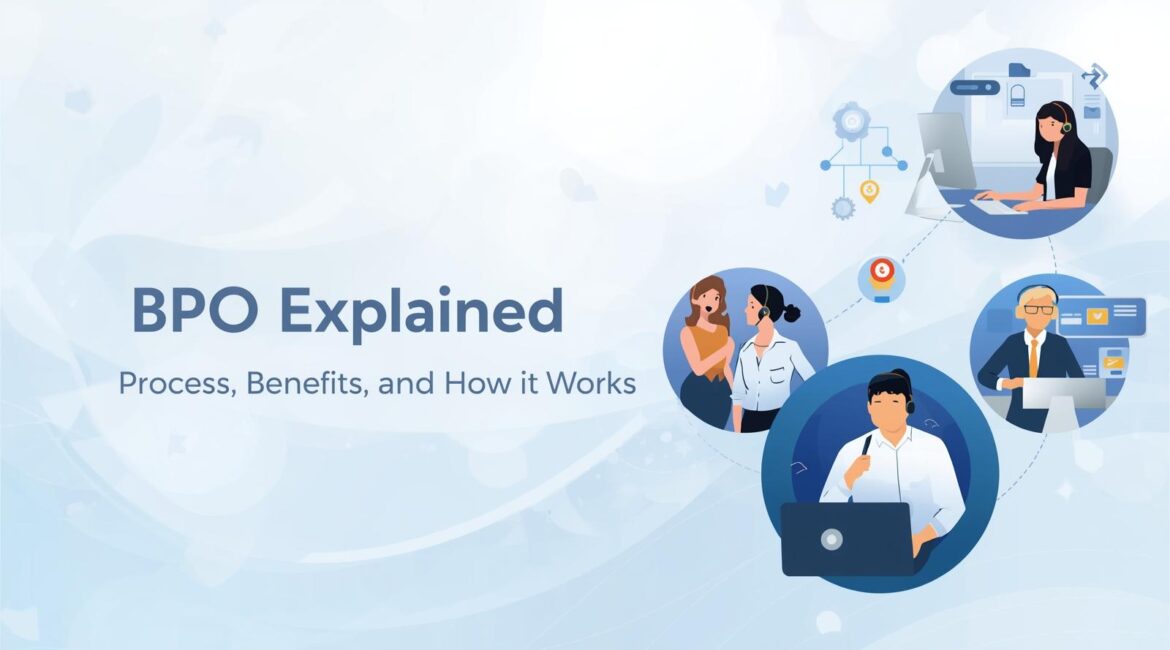
Businesses today face intense pressure to streamline operations while maintaining high service quality and innovation. A reliable BPO service provider helps companies delegate non-core tasks to specialized experts. This approach frees internal teams to concentrate on strategic growth.
Many organizations turn to business process outsourcing services to boost efficiency and adapt quickly to market changes. For instance, companies often outsource customer support or finance operations to gain access to advanced tools and skilled professionals. This shift allows faster scaling without heavy internal investments.
In the third paragraph, business process outsourcing services enable firms to handle fluctuating demand seamlessly. Additionally, they integrate technologies like AI and automation for better outcomes.
The global BPO market reached approximately $328-348 billion in 2025 and continues to expand rapidly, with projections showing growth to around $384 billion in 2026 at a CAGR of about 9-10% through the coming years (sources: Grand View Research, Precedence Research). This surge reflects how companies prioritize operational agility.
What Is Business Process Outsourcing?
Business process outsourcing (BPO) involves contracting third-party vendors to manage specific business functions. Companies hand over repetitive or specialized processes to external providers. This model improves focus on core activities.
BPO differs from traditional outsourcing because it often includes end-to-end management with performance metrics. Providers use advanced systems to deliver consistent results.
For example, a retail company might outsource order processing to ensure 24/7 handling. This setup reduces errors and speeds up fulfillment.
How Does BPO Work? Step-by-Step Process
Companies follow a structured approach when engaging a BPO service provider. First, they assess internal processes to identify outsourcing candidates.
Next, they select a vendor through RFPs and evaluations. Providers demonstrate capabilities via demos and case studies.
Then, both parties sign agreements like service-level agreements (SLAs). These define metrics, timelines, and responsibilities.
Implementation follows with knowledge transfer and system integration. Providers train teams and launch operations smoothly.
Ongoing management includes monitoring performance and regular reviews. Adjustments ensure alignment with business goals.
Finally, optimization uses data insights for continuous improvement.
Key Steps in Engaging a BPO Provider
- Identify processes for outsourcing
- Evaluate and shortlist providers
- Negotiate contracts and SLAs
- Transition operations
- Monitor and refine performance
This process typically takes 3-6 months, depending on complexity.
What Are the Main Types of BPO Services?
BPO services fall into clear categories based on function and focus.
Front-Office BPO Services
These handle customer-facing tasks. Examples include:
- Customer support via phone, chat, or email
- Sales lead generation
- Technical help desk
Front-office outsourcing improves response times and customer satisfaction.
Back-Office BPO Services
These cover internal support functions. Common examples:
- Accounting and finance
- Human resources administration
- Data entry and processing
- Payroll management
Back-office services reduce administrative burden.
Knowledge Process Outsourcing (KPO)
KPO involves high-skill tasks like research, analytics, and legal support. It requires deep expertise.
Industry-Specific BPO
Providers tailor services for sectors like healthcare (claims processing) or finance (compliance).
The following table compares main types:
| Type | Focus Area | Examples | Primary Benefit |
|---|---|---|---|
| Front-Office | Customer interaction | Call centers, sales support | Enhanced customer experience |
| Back-Office | Internal operations | Accounting, HR, payroll | Operational efficiency |
| KPO | Knowledge-intensive | Analytics, research | Access to specialized expertise |
| Industry-Specific | Sector-tailored | Healthcare claims, fintech | Compliance and accuracy |
What Are the Key Benefits of Using a BPO Service Provider?
Partnering with a BPO service provider delivers measurable advantages.
First, companies achieve greater scalability. They handle volume spikes without hiring surges.
Second, access to global talent pools brings specialized skills quickly.
Third, advanced technologies like AI automation integrate faster through providers.
Additionally, risk management improves with expert compliance handling.
Studies show that organizations using BPO report up to 20-30% gains in productivity in outsourced areas (industry benchmarks from reports like those from Grand View Research).
Real-world example: A mid-sized US firm outsourced its customer service. Response times dropped by 40%, and customer satisfaction scores rose significantly.
Moreover, focus shifts to innovation. Internal teams tackle product development instead of routine tasks.
Business process outsourcing services also support 24/7 operations for global customers.
How to Choose the Right BPO Service Provider?
Start with clear objectives. Define what processes to outsource and expected outcomes.
Evaluate providers on experience, technology stack, and security protocols.
Check references and case studies from similar industries.
Assess cultural fit and communication style for smooth collaboration.
Review SLAs for clear metrics and escalation paths.
Pilot small projects to test performance before full commitment.
FAQs
What is the difference between BPO and traditional outsourcing?
BPO focuses on entire processes with end-to-end management, performance guarantees, and often technology integration. Traditional outsourcing may handle isolated tasks without deep oversight.
How long does it take to implement BPO services?
Implementation usually spans 3-6 months. It includes assessment, vendor selection, transition, and stabilization phases.
What industries benefit most from BPO?
Finance, retail, healthcare, telecom, and e-commerce see strong advantages. They gain from scalable support, compliance expertise, and customer service enhancements.
Can small businesses use BPO effectively?
Yes. Small and mid-sized firms often start with targeted services like customer support or accounting. This allows growth without proportional overhead.
How does AI impact BPO services today?
AI automates routine tasks, enables predictive analytics, and personalizes customer interactions. Providers leverage these tools to deliver faster, more accurate results.